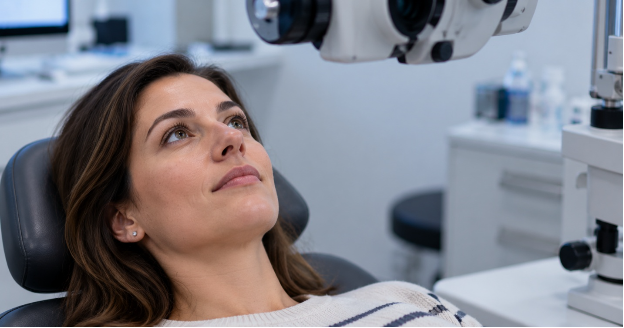
There's a version of this article that gives you five exercises and wishes you luck. I'm not writing that one, because eye exercises help exactly one cause of double vision and do nothing for the rest. Worse, some causes of double vision need attention today, and spending a fortnight on exercises instead is the wrong outcome. So: how to work out which kind you have, when exercises are genuinely the answer, and what the exercises are. This takes ten seconds and tells you more than anything else you'll read here. Cover your left eye. Then your right. Does the doubling disappear when either eye is covered? If it disappears you have binocular diplopia. Both eyes work individually, but they're not pointing at the same place. This is an alignment problem: muscles, nerves, or the coordination between them. Exercises are only relevant in this group, and only for some of it. If it persists with one eye covered that's monocular diplopia. The doubling is happening inside one eye, usually because light is being split before it reaches the retina. Astigmatism, cataracts, dry eye, corneal irregularity. Exercises are completely useless here. A pinhole test usually clears it, which points straight at a refractive cause, and glasses or treating the cataract is what fixes it. Most people who go looking for eye exercises for double vision have never done this test. Do it before you do anything else. Skip everything below and get assessed urgently if any of this applies. Double vision that came on suddenly, over hours or a day or two. Acute binocular diplopia is a red flag in its own right and standard guidance is to investigate it urgently. A drooping eyelid alongside it. A pupil that's larger on one side, especially with headache that combination is a neurosurgical emergency and needs same-day imaging. Any facial droop, arm weakness, slurred speech or sudden confusion. That's a stroke call, meaning 911. Pain around or behind the eye, particularly on moving it. If you're over fifty with new double vision plus a headache, scalp tenderness, or jaw ache when chewing giant cell arteritis needs excluding quickly, because it can take sight permanently. Double vision that's worse in the evening and better first thing in the morning, or that comes and goes with fatigue. That pattern suggests myasthenia gravis and needs proper testing. Double vision after a head injury. One more thing that no article on this seems to mention: stop driving until someone has assessed you. New-onset diplopia is a driving risk regardless of cause. Your eyes have to turn inward together to focus on anything close. When that inward movement is weak or poorly sustained, near work becomes a struggle and when it fails, the image splits. The signature pattern: double vision that only happens close up, comes on after twenty or thirty minutes of reading or screen work, gets worse when you're tired, and disappears entirely when you look across the room. It's been there for months or years rather than arriving last Tuesday. That's a benign condition. It's common, particularly in students and people doing heavy near work. And it responds to exercises, which is why exercises have a reputation they only half deserve. If your double vision doesn't match that description, exercises aren't your answer. These are for convergence insufficiency, confirmed by an exam. I'd rather you did them knowing that than started them on a guess. Pencil push-ups. Hold a pen at arm's length, a small letter on it at eye level. Focus on the letter and bring it slowly towards your nose, keeping it single. When it doubles, stop, hold there a moment, then move it back out until it's single again. Repeat for around fifteen repetitions, once or twice daily. The point is finding where your convergence gives out and gradually pushing it closer. Brock string. A length of string with three beads on it, one end held at your nose. Focus on the near bead you should see the string forming an X crossing at that bead. Move your focus to the middle, then the far one, and watch how the X shifts. This gives you feedback on where your eyes are pointing, which push-ups don't. Near-far focus shifts. Something small held at reading distance, something across the room. Alternate between them, ten seconds each. Less about convergence strength and more about the switching being smooth. A realistic note on results. Home exercises help a proportion of people with convergence insufficiency. Supervised in-office therapy performs better in trials, and this is one of the few areas of vision training where the evidence is solid rather than promotional. If six weeks of home work hasn't shifted anything, that's information, not failure. Because most double vision isn't convergence insufficiency. Prisms. Ground into your glasses or applied as a stick-on Fresnel, they shift the image so your eyes receive it in alignment. This is the workhorse treatment for small stable misalignments, and it works when nothing else will. Treating what's underneath. Thyroid eye disease, myasthenia, diabetes-related nerve palsies the double vision improves as the condition is managed. Microvascular palsies from diabetes or high blood pressure often resolve on their own within about six months. Patching or occlusion. Not a cure, but covering one eye or frosting one lens eliminates the doubling while you wait for something else to work. Useful for people who need to function meanwhile. Surgery. Eye muscle surgery for large or long-standing misalignments that prisms can't manage. Botulinum toxin. Occasionally used to temporarily weaken an overacting muscle while a palsy recovers. The whole question here is which of these you're dealing with, and that isn't something you can determine at home beyond the cover test. What an exam adds: measuring the size and direction of the misalignment, checking each muscle's range of movement, testing near point of convergence with a target, looking at your pupils, checking for lid droop or bulging, and examining the retina and optic nerve. That's what separates a convergence problem from a nerve palsy, and a nerve palsy that can be watched from one that needs imaging this week. If it turns out to be convergence insufficiency, the exercises above are appropriate and you'll know they're aimed at the right target. If it's something else, you'll have found out in an hour rather than after two months of pencil push-ups. Both New Jersey offices see patients for this. Jersey City is on 201-420-7733, Florham Park on 973-994-1444. Call the same day if anything in the red flags section applies. For convergence insufficiency, often yes though some people need occasional refresher periods. For every other cause, no. Exercises don't repair a cranial nerve palsy or realign an eye affected by thyroid disease. Six to twelve weeks of consistent daily practice for convergence insufficiency. Doing them sporadically achieves very little, which is the usual reason people conclude they don't work. Some kinds. Microvascular nerve palsies related to diabetes or blood pressure often resolve within six months without treatment. That's a conclusion for an examination to reach, not one to assume. Usually less alarming than the binocular kind. Monocular diplopia typically comes from astigmatism, a cataract, dry eye or corneal irregularity rather than anything neurological. It still needs identifying, because a cataract causing it is worth treating. Convergence insufficiency is common in school-age children and treatable. A child with double vision needs examining first though, and a child who has suddenly developed it needs examining promptly. The honest summary on eye exercises for double vision: they're effective, narrowly. One condition, well defined, with real evidence behind the treatment. The trouble is that the same symptom has a dozen causes, several of them urgent, and none of the others care how many pencil push-ups you do. Cover one eye. Read the red flags. Then book an exam, and let the exercises follow the diagnosis rather than replace it.First, cover one eye
When double vision needs seeing today
The one cause exercises genuinely fix
The exercises themselves
What treats the other causes
Why the exam matter more than the exercise
FAQ
Can eye exercises cure double vision permanently?
How long do eye exercises take to work?
Can double vision go away on its own?
Is double vision in one eye serious?
Can children do these exercises?
Start with the diagnosis
Something's gone wrong with your eyes and you're standing in the kitchen trying to work out whether this is an emergency room situation or a...
Yes. Awake, aware, and looking at a small light the whole time. That's the answer people don't want, and it's the reason this gets searched ...
Struggling with dry eye? Schedule a dry eye evaluation and find out if OptiLight is right for you.
Book Appointment
Where to Go for Emergency Eye Care

Eye Tracking Problems: What They Are, and What They Aren't

Can Urgent Care Treat Pink Eye? What They Can and Can't Do