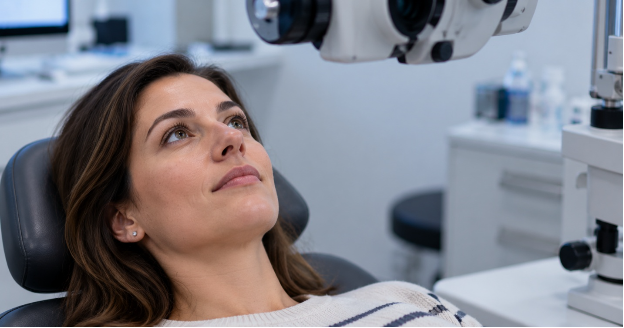
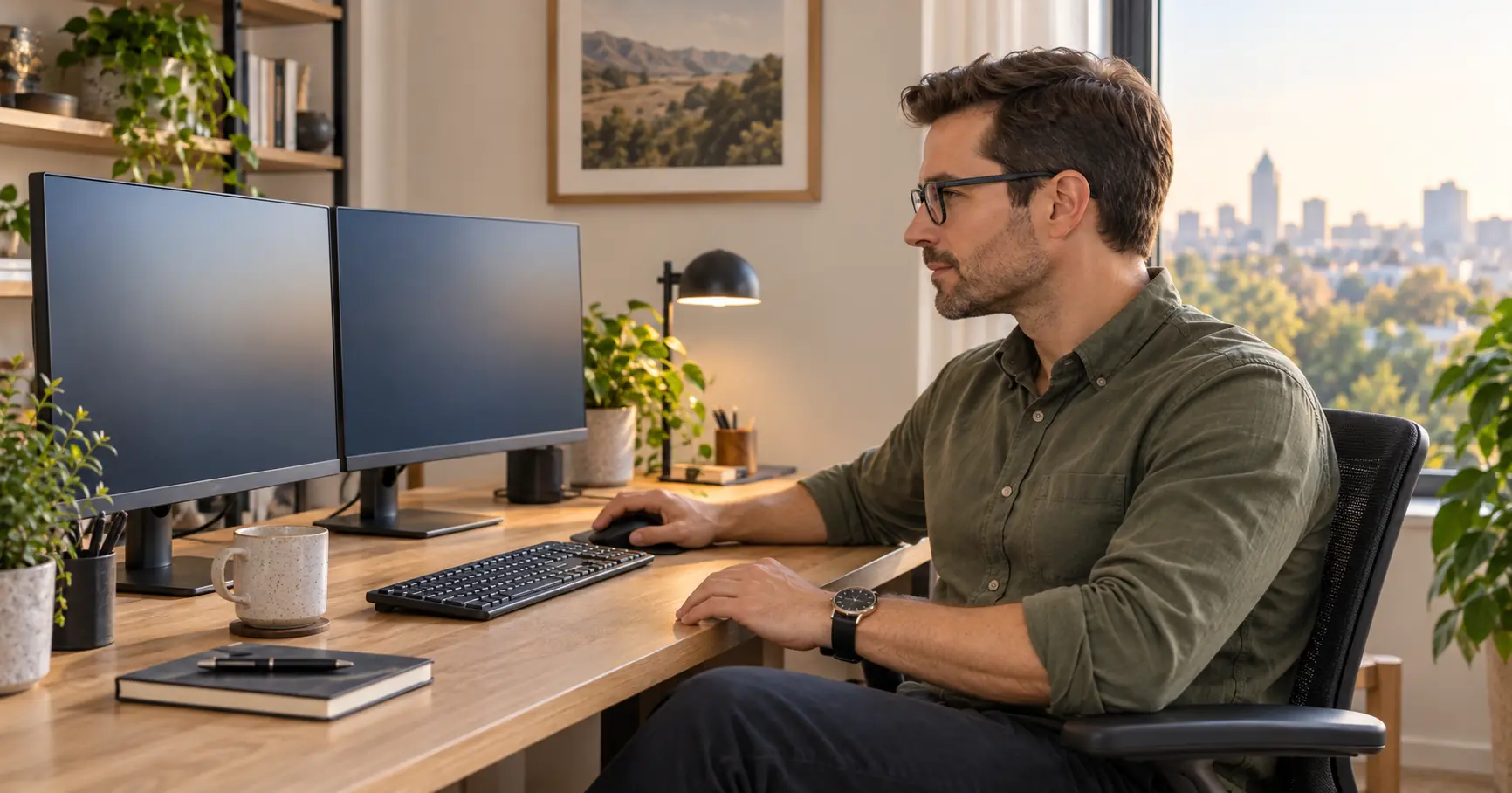
No. Not in any permanent, structural sense, and the American Academy of Ophthalmology is unambiguous about it. There's one real exception, and it applies to children rather than adults. I'll come to that, because it's the part worth taking seriously while everyone argues about blue light. Your eyes will feel awful after nine hours at a monitor. That's real, it's measurable, and it has a name digital eye strain, or computer vision syndrome. The symptoms: aching or tired eyes, blurred vision that comes and goes, dryness, burning, headache around the brows, sometimes intermittent double vision. Neck and shoulder pain usually tags along. Every one of those is temporary. Rest and they resolve. Nothing about a screen alters the structure of an adult eye. The important distinction is that these symptoms come from how you use the screen rather than from anything the screen emits. Duration, blink behavior, posture, lighting, and whether your prescription is right for the distance you're working at. Worth dealing with directly, since it's what most people are actually asking about. There's no scientific evidence that blue light from digital devices damages your eyes. The AAO says so plainly and, on that basis, doesn't recommend blue light glasses or any special eyewear for computer use. The physics supports it. Blue light from screens is a fraction of what you get from the sun, and it's no more damaging than the sun's. If you spend an afternoon outside without sunglasses, you've had vastly more blue light exposure than a full working day at a monitor. Discomfort at screens isn't caused by blue light. It's caused by staring. One AAO spokesperson made a sharper point: taking preventive measures against blue light, given there's no evidence of harm, may be more harmful than the blue light itself because it substitutes for the things that genuinely help. Evening screen use and sleep is a different question. Light in the evening does affect sleep, and night mode plus less screen time before bed handles that without buying anything. Yes, and this is the mechanism behind most screen discomfort. The standard explanation is that you blink less. That's broadly right, and there's a more precise version worth knowing. Newer research found blink rates during computer use sit around 14.9 a minute compared with 13.6 while reading print barely different. What drops sharply is blink quality. Screen blinking is largely incomplete: the lids don't fully meet, so the tear film never gets properly resurfaced across the lower part of the eye. That matters because it changes the advice. "Blink more" is less useful than "blink fully." A deliberate, complete closure every so often does more than a flurry of half-blinks. There's a second factor most people never hear about. When you look straight ahead at a monitor, your eyes are wider open than when you look down at a book. More exposed surface area means faster evaporation. The angle of your gaze is doing real work here. Add air conditioning, low humidity and a vent pointed your way, and dry eyes from computer work become almost inevitable. Following directly from that: set the screen so you're looking slightly downward at it. The top of the monitor should sit at or just below eye level, roughly at arm's length about 25 inches. That downward gaze narrows the eye opening, reduces the exposed surface, and cuts evaporation. It's the single cheapest change on this list and most people have their monitor too high, particularly anyone working from a laptop on a stand. Everything above applies to adults with finished eyes. Children are different, and this is where "does screen time damage your eyes" gets a less comfortable answer. Myopia rates have risen sharply since the 1970s, and research links this to children spending more time on near work and less time outdoors. A myopic eye is physically longer than it should be, and that length is permanent. It carries raised lifetime risk of retinal detachment, glaucoma and macular disease decades later. So for a child, heavy near work isn't causing temporary strain. It may be contributing to a structural change that stays. Two clarifications, because this gets overstated in both directions. It probably isn't the screen specifically. Near work of any kind is implicated books do something similar. The screen is just what near work looks like now. And the strongest protective factor is time outdoors, which appears to be about light intensity rather than the activity. What a screen mainly does is displace that time. If your child is nearsighted, there are treatments that slow the eye's elongation while it's still growing specialized contact lenses, spectacle lenses designed for the purpose, and low-dose atropine drops. That's a conversation worth having early, because the prescription a child finishes growing with sets their risk profile for life. The 20-20-20 rule. Every twenty minutes, look at something twenty feet away for twenty seconds. It relaxes the focusing system, which has been held at one distance for hours. Complete blinks. Deliberate, full closures, several times an hour. Monitor at arm's length, top at or below eye level. Sort out the glare. Screens facing a window are worse than screens beside one. Overhead fluorescents are worse than lamps. Preservative-free artificial tears when your eyes feel dry, as often as you like. Move the air vent. And get your prescription checked for the distance you actually work at. Uncorrected astigmatism or long-sightedness makes screen work far harder than it needs to be, and computer glasses set for intermediate distance rather than reading distance are a genuinely useful option for people who spend all day at a monitor. Those aren't the same thing as blue light glasses. Most screen discomfort is exactly what it looks like. Some isn't. Get examined if your vision blurs and doesn't clear with rest, if you're getting double vision, if headaches are severe or waking you, if symptoms are much worse in one eye, or if you have dryness that artificial tears don't touch. Persistent dryness in particular often turns out to be meibomian gland dysfunction rather than screen habits, and treating that is a different job from taking more breaks. A full refraction, including at the working distance you actually use, which a standard distance test doesn't cover. Tear film assessment how quickly it breaks up, what the oil glands are producing, whether there's damage to the surface. And how the eyes work together at near, since convergence problems cause a lot of what gets blamed on screens. Where dryness turns out to be gland-related, intense pulsed light treats the glands rather than the symptom. We use OptiLight at both offices. Jersey City is on 201-420-7733. Florham Park on 973-994-1444. No, and the same applies to the old warning about sitting close to the television. It's uncomfortable rather than damaging. The evidence doesn't support them for eye strain, and the AAO doesn't recommend them for computer use. If they help you, it's likely because wearing them prompts more breaks. For evening sleep, night mode achieves the same thing at no cost. The dryness itself is reversible. Chronic untreated dry eye can progress and damage the corneal surface over years, so it's worth treating rather than tolerating indefinitely. There's no threshold. Symptoms track how you use the screen more than how long — someone taking proper breaks at eight hours often does better than someone staring uninterrupted for four. Getting them outdoors matters more than restricting screens. Forty to eighty minutes of outdoor time a day is associated with lower rates of myopia developing. So, does looking at a computer screen damage your eyes? For an adult, no you get real symptoms that resolve with rest and better habits, and nothing permanent. For a child, the picture is less settled and worth acting on, because myopia is a structural change rather than a temporary one. Either way, if your eyes hurt at the end of every working day, that's worth an examination rather than a browser tab of tips. Frequently it's a prescription that's wrong for the distance, or a tear film problem that's treatable.What screens do
The blue light question
Can screens cause dry eyes?
Why monitor height matters more than you'd think
The exception that actually matters
What actually helps
When it isn't just eye strain
What we look at
FAQ
Will sitting too close to a screen ruin my eyes?
Do blue light glasses work for eye strain?
Can screens cause dry eyes permanently?
How many hours of screen time is too much for eyes?
Should I limit my child's screen time to protect their eyes?
The short version
Your eyes don't glide smoothly across a line of text. They jump. Small, fast movements, several to a line, with tiny pauses in between where...
Yes. They'll see you, they'll look at the eye, and you'll probably leave with a prescription in your hand. Did you need it, though? Nobody a...
Struggling with dry eye? Schedule a dry eye evaluation and find out if OptiLight is right for you.
Book Appointment
Eye Tracking Problems: What They Are, and What They Aren't

Can Urgent Care Treat Pink Eye? What They Can and Can't Do