
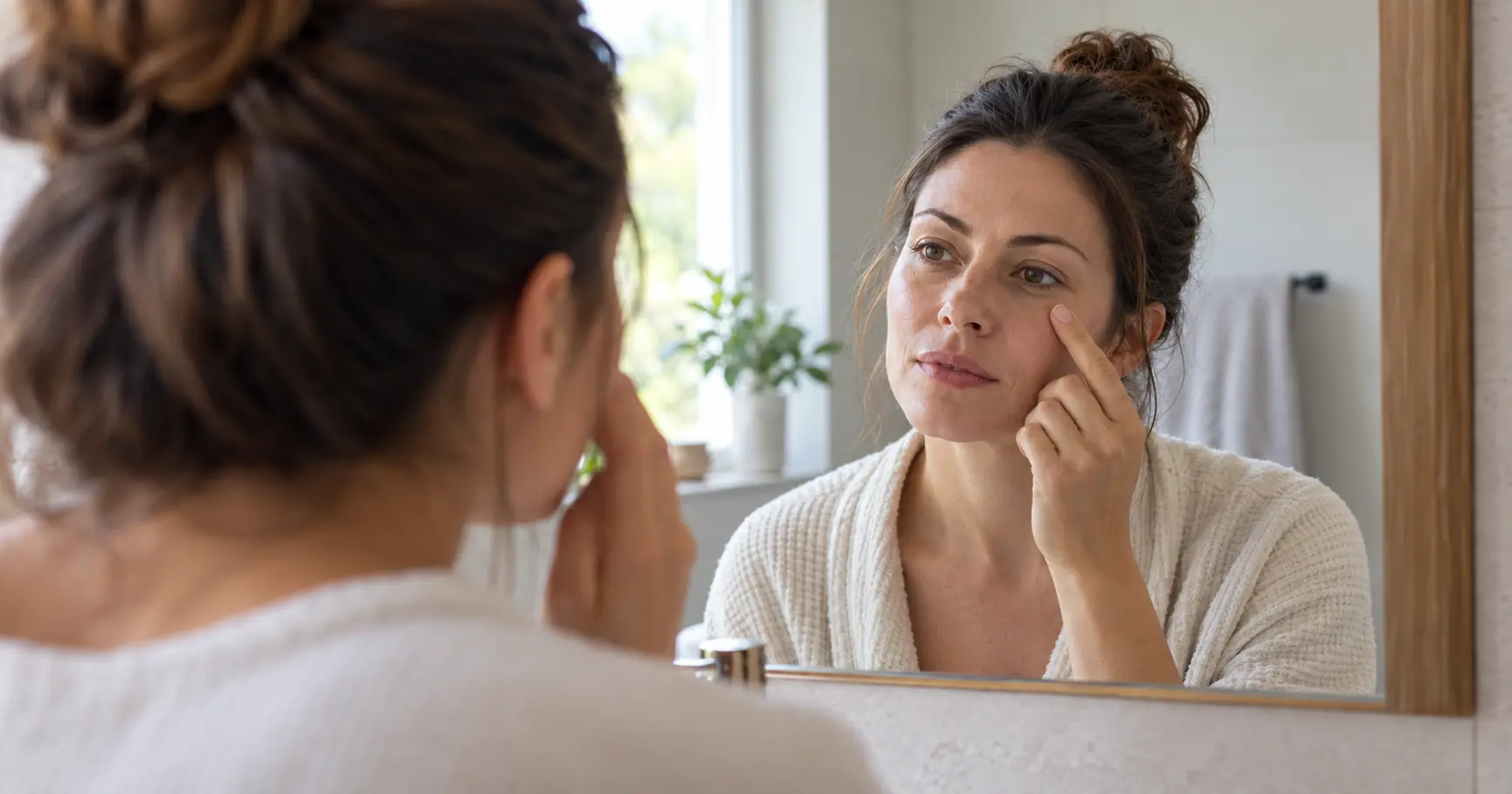
Most likely something touched them that shouldn't have. And there's a decent chance it wasn't anything you put near your eyes deliberately. Eyelid skin is the thinnest on your body. It has very few oil glands, it sits in constant motion, and it's accessible to your fingers all day long. So it reacts first and it reacts to things the rest of your face shrugs off. Here's how to work out what's causing yours. Worth separating these before anything else, because they get conflated constantly and they need different treatment. Dry eyelid skin is a skin problem. Flaking, tightness, redness, itching, sometimes cracking at the outer corner. It's on the outside. Dry eye is a tear film problem. Grittiness, burning, fluctuating vision, watering. It's on the surface of the eye itself. You can have one, the other, or both and having both is common, because the inflammation involved tends to spread across the lid margin in either direction. If your vision blurs and clears when you blink, that's the tear film, and it needs addressing separately from the skin. Contact dermatitis, and it isn't close. Studies of eyelid dermatitis put allergic contact dermatitis at somewhere between 55% and 74% of cases, with irritant contact dermatitis accounting for another 15%. Atopic eczema sits under 10%, and seborrheic dermatitis around 4%. Allergic means your immune system has decided it dislikes a specific substance. That reaction can develop to something you've used happily for years sensitization takes time, and its arrival has nothing to do with changing product. Irritant means the substance is simply harsh on thin skin. No immune involvement, more of a dose-and-frequency problem. They look similar and the distinction matters mainly for treatment, which is one reason this benefits from being properly identified rather than guessed at. This is the most useful thing on this page. Dermatology has mapped the distribution patterns, and they point at different sources. Both upper and lower lids, both eyes. Direct exposure. Something applied to the eye area makeup, cleanser, moisturizer, eye drops. One eyelid only. Almost always transfer from your hands. Something on your fingers that you rubbed in without thinking. Gold and nail products are the classic culprits here. Also worth considering anything you press one eye against a camera viewfinder, a microscope eyepiece, a phone held to one side. Lower lids and the upper cheeks. A runoff pattern. That's liquid tracking down your face, which means eye drops or contact lens solution. Upper lids plus the sides of the nose and the upper chest. Airborne exposure. Fragrances, aerosols, household cleaning sprays, anything in the air that settles on exposed skin. Look in the mirror and work out which pattern you have. It narrows the search considerably. Nail products. Acrylates in gel polish, regular polish and artificial nails are a well-documented cause of eyelid dermatitis, transferred whenever you touch your face. The hands themselves usually look completely fine, which is why nobody makes the link. If you've had a manicure and your eyelids flared afterwards, that's worth testing dermatologists often recommend stopping nail products entirely for eight weeks to find out. Hair products. Shampoo and conditioner run over your face in the shower. Cocamidopropyl betaine, a surfactant in most of them, is a common eyelid allergen. So is methylisothiazolinone, a preservative widely used in hair products and lotions. Hair dye chemicals can affect the lids even when the scalp is completely clear. Eye drop preservatives. This one catches out people who are already treating dry eye. Benzalkonium chloride, the most common preservative in ophthalmic drops, is a recognized skin irritant. It's in many artificial tears and in a long list of prescription drops. If your eyelid trouble started after you began using drops regularly, switching to preservative-free is the first thing to try. Metal. Nickel from eyelash curlers and tweezers. Gold is documented as the most common cause of one-sided eyelid dermatitis via transfer. And nickel in spectacle frames, which sits against the skin for twelve hours a day if the dryness is worst where your frames touch, that's a straightforward fix. Topical antibiotics. Neomycin, bacitracin and polymyxin are frequent sensitizers. If you were given an ointment for an eye infection and things got worse rather than better, the ointment may be the problem. Makeup brushes and applicators. Including the residue of whatever you clean them with, if it isn't fully rinsed out. Seborrheic dermatitis. The same condition behind dandruff. Greasy yellowish scaling rather than dry flaking, and it usually involves the lash line, which means blepharitis is part of the picture. Atopic eczema. If you had eczema as a child or have hay fever and asthma, your skin barrier is more permeable and the eyelids are a common site. These people are also more prone to developing contact allergies on top. Rosacea. Facial flushing often comes with eyelid involvement, and it responds poorly to moisturizer alone. Environment. Winter air, indoor heating, air conditioning, long hot showers. Straightforward moisture loss through very thin skin. Over-washing. Scrubbing the area, using foaming cleansers on it, or applying lid wipes several times a day strips what little oil is there. A surprising number of people arrive with dryness caused entirely by their treatment of it. Thyroid conditions and Sjögren's both affect skin and tear production, and both are worth mentioning to your doctor if the dryness is persistent and generalized. Stop everything on the eye area for a fortnight. All of it makeup, eye cream, cleanser, serums. You cannot identify a trigger while twelve products are in rotation. Wash with water only, lukewarm, and pat dry rather than rubbing. Use a plain fragrance-free ointment rather than a lotion. Petrolatum-based products seal moisture in and contain almost nothing to react to. Lotions contain more ingredients and more preservatives. Switch to preservative-free artificial tears if you use drops at all. Skip nail treatments for the duration. Keep your hands off your face, which is harder than it sounds and matters more than anything else on this list. Then reintroduce products one at a time, a week apart. Tedious, and it works. Come in if it's been going on more than a few weeks, if it keeps returning, or if the lid margin and lashes are involved rather than just the skin. Sooner if the eye itself is red or painful, if your vision has changed, if there's spreading redness or swelling with fever, or if a lash line area is crusting persistently. And promptly for anything that's only on one side, hasn't shifted with treatment, and involves lash loss or a change in the skin's texture or color. Persistent one-sided eyelid changes need examining properly rather than moisturizing. Honest about scope here. We can identify blepharitis and meibomian gland dysfunction, which cause a large share of lid-margin dryness. We can assess the tear film, check whether your drops are the problem, look at whether your frames are contributing, and examine the eye itself for anything that shouldn't be there. What we don't do is patch testing. If it turns out you have allergic contact dermatitis, identifying the specific allergen requires a dermatologist and a proper patch test panel that's the definitive answer and it's worth getting if this keeps recurring. Plenty of people need both, and that's fine. Starting with an eye exam tells you which of the two you need. Jersey City is on 201-420-7733. Florham Park on 973-994-1444. Cold air holds less moisture, indoor heating dries it further, and hot showers strip oil from skin that has very little to begin with. Eyelid skin shows it first because it's the thinnest you have. Better not to. Most face creams contain fragrances and preservatives that eyelid skin reacts to even when the rest of your face is fine. A plain fragrance-free ointment is safer. No. Contact dermatitis, eczema and seborrheic dermatitis all stem from your own skin and immune system rather than anything transmissible. Usually transfer from your hand. Something on your fingers nail product, hand cream, metal residue that reached one eye and not the other. One-sided dryness that persists despite treatment should be examined rather than assumed. Usually not. Stop during a flare, reintroduce one product at a time afterwards, and replace anything older than six months. Most people identify one culprit and keep the rest. Yes, and it's commonly missed. Benzalkonium chloride in preserved drops irritates skin with repeated use. If you're using drops more than a few times a day, preservative-free is the better choice regardless. So, why are my eyelids dry? Most often because something reached them that your skin objects to, frequently carried there by your own hands from your nails or your hair. Work out which pattern matches yours, strip the routine back to nothing for two weeks, and reintroduce slowly. That solves a good proportion of cases without anyone needing to see you. For the ones it doesn't solve particularly where the lash line is involved, or it keeps coming back get it examined rather than continuing to guess.Dry eyelids and dry eyes are different problems
The cause that accounts for most cases
Where it sits tells you where it came from
The hidden causes people never connect
The other causes worth knowing
What to try this week
When to have it looked at
Who you should actually see
FAQ
Why are my eyelids so dry in winter specifically?
Can I put regular moisturizer on my eyelids?
Is dry skin on eyelids contagious?
Why is only one eyelid dry?
Should I stop wearing eye makeup permanently?
Could my eye drops be causing it?
Start by narrowing it down
Yes. And it's one of the most commonly missed explanations for blurry vision I see. There's a specific pattern to it, too. If your vision go...
Yes, though the connection is more interesting than most explanations suggest. There are three separate mechanisms at work, and they're not ...
Struggling with dry eye? Schedule a dry eye evaluation and find out if OptiLight is right for you.
Book Appointment